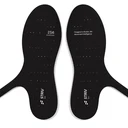


Does your body weight change how your running shoes cushion?
Under the ball of your foot, your weight matters less than you'd think. The shoe you pick matters more.
Spend ten minutes at the shoe wall of a running store and you will hear both halves of the same advice. Bigger runners get steered toward the thickest, softest foam. Lighter runners hear that a plush trainer is wasted on them, because they will never sink far enough into it. It sounds like simple physics: soft foam should behave differently under 130 pounds than under 210.
We wanted to check it against real feet. So we took push-offs from 49 STRIV runners, lightest to heaviest, and placed each one on lab foam tests of 68 shoes. Here's what we found under the ball of the foot.
The short answer
Under the ball of your foot, mostly no. At push-off, the shoe you're in decides how far its forefoot foam squashes. Most runners in the same shoe squash it within about 2.6 mm of each other, while one runner switching shoes can go from about 11 mm to about 26 mm. Weight moves it a little.
What did we look at?
We followed 49 STRIV runners through 244 of their runs, from September to November 2026. They ranged from our lightest to our heaviest, and each ran in a shoe model they picked themselves.1
For the foam, we used running-shoe lab tests from RTINGS. Their lab presses each shoe's foam and records how far it gives as the press gets harder. We used the forefoot results for 68 shoes. The hardest press in that test is roughly the weight of a 470-pound person standing still.2
Then we placed each runner's push-off on the foam test of the shoe they ran in, and on every other shoe in the set. Same runner, different shoes.

Does a heavier runner squash the foam further?
A little. Heavier runners in our group did push the forefoot foam a bit further. But in any one shoe, most of our runners were within about 2.6 mm of each other, roughly a tenth of an inch.1
Now keep the runner and change the shoe. In the firmest shoes, a typical push-off squashed the foam about 11 mm, under half an inch. In the softest, about 26 mm, close to an inch. That's more than twice as far, for the same feet.
How you move in a shoe can vary a lot from runner to runner. How far its foam squashes mostly doesn't.

Are you too light for soft running shoes?
It's a common worry, and some shoe guides draw a line at 200 pounds. The idea is that a light runner never sinks far enough into soft foam for it to matter.
Under the ball of your foot, that isn't what we saw. At push-off, about twice your body weight goes through the front of your foot. That squashes the forefoot foam most of the way down to where the lab's hardest press takes it. Our runners under 60 kg, about 130 pounds, still went most of the way down.1
We checked: it holds even if our force numbers were off by a lot. At the forefoot, a soft shoe isn't wasted on a light runner.

What about the heaviest runners?
About 1 in 7 of our runners, all over about 90 kg (roughly 200 pounds), pushed off harder than the lab's hardest press on some of their runs. Their push-offs go past where the test stops, so the curve can't show how much further the foam gives for them.1
Do lab foam tests apply to you?
For the forefoot foam, mostly yes. We ranked the 68 shoes by how much energy their foam gives back at each runner's own push-off. For 47 of our 49 runners, the top shoe was the same one the lab's own results put first. For the other two, the gap was tiny.1
So a lab test is a fair guide to how a foam behaves under you. How a pair feels on your long run is still yours to find out.

What didn't we look at?
Only the front of the foot, at push-off, in shoes our runners chose for themselves. Landing is a separate question. In one lab study, researchers used an automated drop test on an artificial heel to mimic runners of different body mass and speed. They suggested that cushioning chosen for a runner's weight could be a better match there.3
Still, under the ball of your foot, the number on the scale isn't much of a guide. Pick on feel and fit.
See the foam under each pair
Shoe Center in the STRIV app shows what each pair is built on. Choose the model for a pair and you'll see its midsole drawn to scale, the heel and forefoot height, the drop, and how soft the foam is, from Very soft to Very firm. The details come from lab measurements of that model, not from your runs.
Find it: The Movement Profile tab, under Your Shoes. A pair with no model yet shows Choose model.
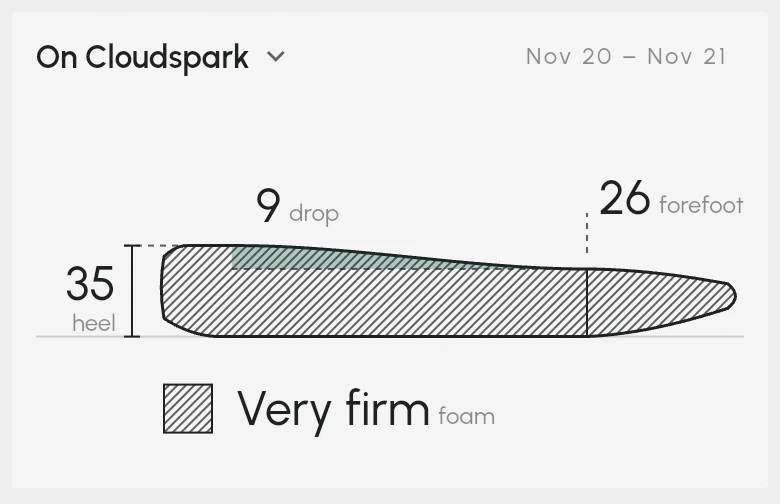
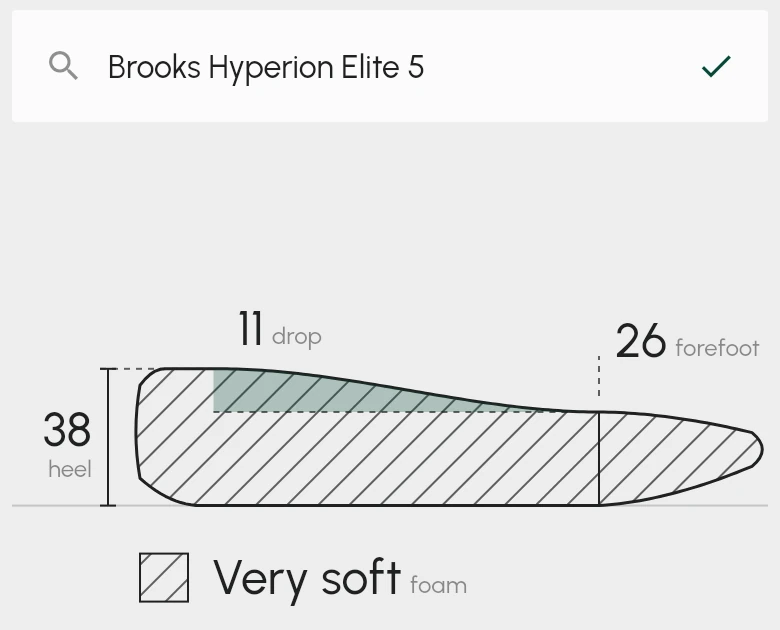
Drawn to scale
Each pair's card draws its midsole side on, heel on the left, with the heel and forefoot height and the drop between them.
Very soft to Very firm
Foam softness in five steps, shown with the drawing as soon as you pick the model for a pair.
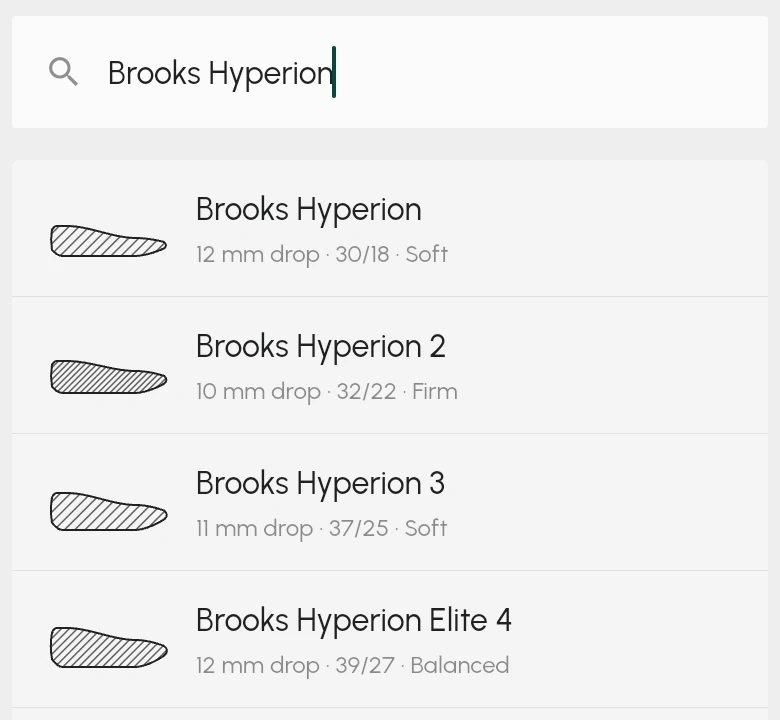
Every model at a glance
When you add a shoe, each model in the list has a small midsole sketch and one line: drop, heel and forefoot height, and softness.
Common questions
Can a running shoe be too soft for a light runner?
Not at the forefoot, going by our data. At push-off, our lighter runners still squashed the front of the foam most of the way down. If a soft shoe feels good to you, your weight is no reason to pass on it.1
Do heavier runners need max-cushion shoes?
Should I pick a running shoe by my weight?
Under the ball of your foot, your weight is a small part of the story. Switching pairs can more than double how far the foam squashes. Start with how a shoe feels and fits, and try a few if you can.
Where can I see how soft my own shoes are?
In Shoe Center, on the Movement Profile tab under Your Shoes. Choose the model for a pair, and its card shows the midsole drawn to scale and the foam from Very soft to Very firm.
References
- STRIV analysis of 49 runners, Sept–Nov 2026STRIV Team. STRIV, 2026.
- Running shoe lab testsRTINGS.com. RTINGS.com, 2026.
- The Effect of Body Mass on the Shoe-Athlete InteractionTsouknidas A, Pantazopoulos M, Sagris D, Fasnakis D, Maropoulos S, Arabatzi F, Michailidis N. Applied Bionics and Biomechanics, 2017.
STRIV turns repeated pressure and motion signals into a personal view of how running mechanics change over time. Insights are educational, not a medical diagnosis, and they do not predict injury or measure race fitness.