
Why mileage is only half of your running load
Two runs can share a distance and ask very different things of your legs.

Ask a runner how training is going and you'll usually get a number. Thirty miles last week. Now picture two 6-mile runs from the same week. One was an easy loop on the flat, chatting the whole way. The other was hill repeats on tired legs after a short night. Same number in the log. Not the same day for your legs.
Distance tells you how far you went. It doesn't tell you what the run asked of your body. That other half has a name, musculoskeletal load, and it's worth getting to know. Here's what it means, what research says about "too much", and a simpler way to think about it.
The short answer
Mileage counts how far you ran. Load is what those miles asked of your muscles, tendons and bones, and pace, hills and tired legs all change it. There's no single safe number. The more useful check is against yourself: is this a big step up from your recent training, and did several things change at once?
What does musculoskeletal load mean?
Musculoskeletal means your muscles, tendons and bones, and the joints where they meet. Load is the mechanical demand a run puts on them: the pushing, pulling and absorbing they do on every step, added up over the whole run.
Researchers who study running injuries keep two ideas apart. One is the load a run puts on a part of your body. The other is that part's capacity to handle it on the day. In their framework, injury is what can happen when load goes beyond capacity.1
So load is the demand, not the state of your body. How well you handle it depends on everything else you bring to the run.
Why can two runs of the same distance ask such different things?
Pace is one reason, and not always in the direction you'd guess. In a lab study of 16 recreational runners, each step at a slower pace put less load on the knee. But slow running takes more steps to cover the same ground. Over 1,000 meters, the total load at the knee was about 80% higher at the slowest pace than at the fastest.2
80%about how much higher the total load at the knee was over 1,000 meters at the slowest pace than at the fastest.2
That doesn't make easy runs a problem. It means an easy run isn't automatically light on your legs.
What do hills and tired legs add?
Hills change the job, too. Running uphill asks your leg muscles to do more work to lift you. Running downhill is mostly about absorbing energy as you come down, a different kind of demand on the same legs.3
Tiredness matters because capacity isn't fixed. The same framework counts a drop in capacity during a run as its own part of the story, so your last miles land on legs that have already done a lot.1
Does the 10% rule keep you safe?
It's one of the most repeated rules in running: don't add more than 10% a week. In a trial of 532 new runners training for a 4-mile race, one group followed a gradual 13-week plan built on the 10% rule and the other a standard 8-week plan. About one in five got injured in each group: 20.8% and 20.3%.4
That doesn't mean big jumps are fine. In a year-long study of 874 new runners, those who raised their weekly distance by more than 30% had a higher rate of some distance-related injuries, like runner's knee and shin splints, than those who raised it by less than 10%. The gap could still have been chance, and the authors called their study exploratory.5
A review of studies on sudden changes in training found only four that qualified. Three linked increases with more injuries, yet the reviewers called the evidence very limited. The changes that counted included running faster and running more often, not only running farther.6
So how much is too much?
The broader link between training load and injury is well supported. In a review of 57 studies across sport, the military and first responders, most found some relationship. It was strongest for how hard training felt, and it didn't always point the same way.7
So there's no number that holds for everyone. Too much compared with what? Your own recent training is the most useful yardstick.
Is this week a big step up from what you've been doing lately, in distance, pace or hills? Did several of those change at once? How did it feel, during the run and the day after? New hills, a faster group and an extra long run in the same week add up, even if your mileage barely moved.
And if something hurts in a way that changes how you run, that's a question for a physio, not a spreadsheet.
See what each run asked of your legs
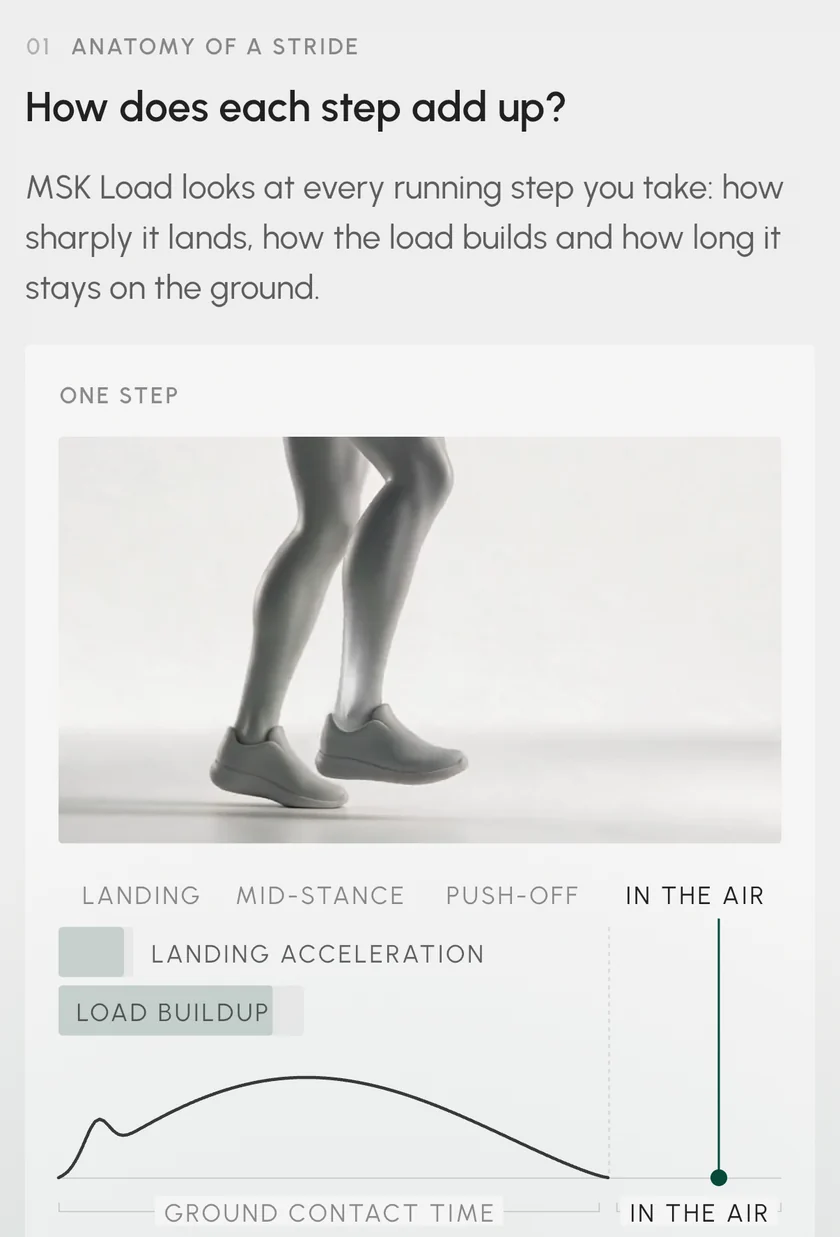
MSK Load in the STRIV app adds up what each run asked of your muscles, bones and joints. A bigger number means more running added up, not a better or worse run. Use it to follow how your training changes over time.
Find it: Tap MSK Load on Home, or open it from any run.
Up or down from usual
The top of the screen shows your current load and how far it sits above or below your usual week.
Load and intensity
Load is how much a run added up. Intensity is how hard each step landed, and it doesn't grow with distance.
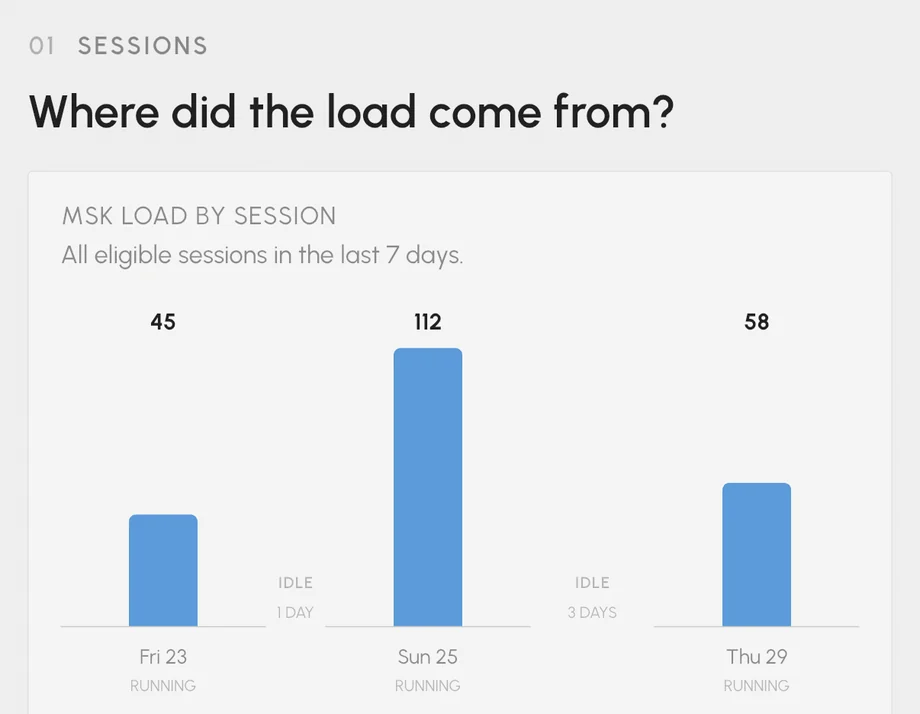
Where it came from
A bar for each recent run, with the days between them, shows which runs carried the most.
Common questions
Is slow running easier on your body?
Per step, yes, at the knee. Over the same distance, not always. In one lab study, slow running added up to more total knee load over 1,000 meters, because it took more steps.2
Does running downhill count as an easy run?
Up to a fairly steep grade, it costs less energy than running on the flat. Your legs are doing a different job, though: absorbing energy as you come down.3
Can tracking my load prevent injury?
Not on its own. Load is only part of the story, and no single number can tell you that you are safe.
What tracking can do is show you when your training changed, so you can decide what to do about it.
Is a higher MSK Load better or worse?
Neither. It isn't a score out of 100 but a total, so a bigger number means more running added up. Use it to follow how your training changes over time.
References
- A framework for the etiology of running-related injuriesBertelsen ML et al.. Scandinavian Journal of Medicine & Science in Sports, 2017.
- Cumulative loads increase at the knee joint with slow-speed running compared to faster running: a biomechanical studyPetersen J, Sørensen H, Nielsen RØ. Journal of Orthopaedic & Sports Physical Therapy, 2015.
- Biomechanics and Physiology of Uphill and Downhill RunningVernillo G et al.. Sports Medicine, 2017.
- No effect of a graded training program on the number of running-related injuries in novice runners: a randomized controlled trialBuist I et al.. American Journal of Sports Medicine, 2008.
- Excessive progression in weekly running distance and risk of running-related injuries: an association which varies according to type of injuryNielsen RØ et al.. Journal of Orthopaedic & Sports Physical Therapy, 2014.
- Is there evidence for an association between changes in training load and running-related injuries? A systematic reviewDamsted C, Glad S, Nielsen RO, Sørensen H, Malisoux L. International Journal of Sports Physical Therapy, 2018.
- The Relationship Between Training Load and Injury in Athletes: A Systematic ReviewEckard TG, Padua DA, Hearn DW, Pexa BS, Frank BS. Sports Medicine, 2018.
STRIV turns repeated pressure and motion signals into a personal view of how running mechanics change over time. Insights are educational, not a medical diagnosis, and they do not predict injury or measure race fitness.