
One thing to think about on your next run
A checklist is hard to hold at mile three. One cue you can feel is easier to carry out the door.

You read the list before you left: land under your hips, quick steps, run tall, relax your shoulders, swing your arms forward and back. By the end of your street you're checking your elbows. By the first hill you've forgotten all of it, and you're just running again.
That isn't a lack of discipline. A list of ten fixes is built for reading, not for running. What you can actually take out the door is smaller: one cue you can feel, and a little strength work on the days in between. Here's what research says about both.
The short answer
Pick one simple cue that points at the result you want, like "land quietly", instead of a list of body parts to adjust. In lab studies, thinking hard about the running movement made runners less economical, while cues to run quietly lowered landing force. Strength work between runs generally helps economy too.
Can thinking about your form make you run less efficiently?
It can. In one study, trained runners on a treadmill spent ten minutes each focusing on their running movement, on their breathing and on their surroundings. They were most economical, using the least oxygen at the same speed, when their attention was on their surroundings.1
A later study pointed to one possible reason. When twelve runners focused on their running movement, they bounced up and down more than when they watched a video, and they used more energy. In the researchers' words, it moved runners "away from their optimised running pattern."2
Your stride already runs on autopilot. Picking it apart joint by joint can get in its way.
What makes a cue easy to carry?
It points at what you want to happen, not at a body part. "Land quietly" is about the sound your feet make. "Push the ground away behind you" is about the ground. You can feel both without checking your knees, ankles and hips one by one.
A good cue is also short enough to say in one breath, and you can tell when you're doing it. If you hear your footsteps get softer, the cue is doing its job.
Does "land softly" actually change anything?
In the lab, it seems to. When 26 men were simply told to run quietly, their landings got quieter, the peak landing force dropped, and the force built up less sharply.3
In 37 runners with injuries, cues for quiet, soft landings in shoes lowered how sharply the landing force built, about as much as asking them to run barefoot and land on the forefoot. And changes like this can stick once practiced: ten runners who trained with real-time feedback on their landings cut how sharply the force built by about 30%, and the drop held at a one-month check.4,5
30%about how much ten runners cut how sharply their landing force built, after training with real-time feedback.5
These were small studies that measured landings, not injuries. Treat a softer landing as something to feel, not a fix for everything.
Why just one cue?
Because attention is the scarce part of a run. Traffic, pace, a hill and the friend beside you all ask for it. One cue fits in the space that's left. Ten don't.
Try it in small doses. Think about it for a minute or two, let it go, and come back to it at the next landmark. If it starts to feel forced, drop it for the day. The next run is another chance.
What helps between runs?
Strength work. A review of 24 studies of distance runners found that adding strength training to running generally made runners more economical, meaning they used less energy at the same pace. The gains were usually 2–8% compared with running alone, though not every study found one.6
The kind of work matters. A 2024 analysis found the clearest gains in economy from heavier lifting, jump training, or a mix of methods.7
One thing to try on your next run
Focus in the STRIV app gives you one thing to work on, chosen by Ace from your runs. It pairs a cue for your next run with a few exercises to do at home, each with a short demo.
Find it: Home, your Movement Profile and the screen where you set up a run.
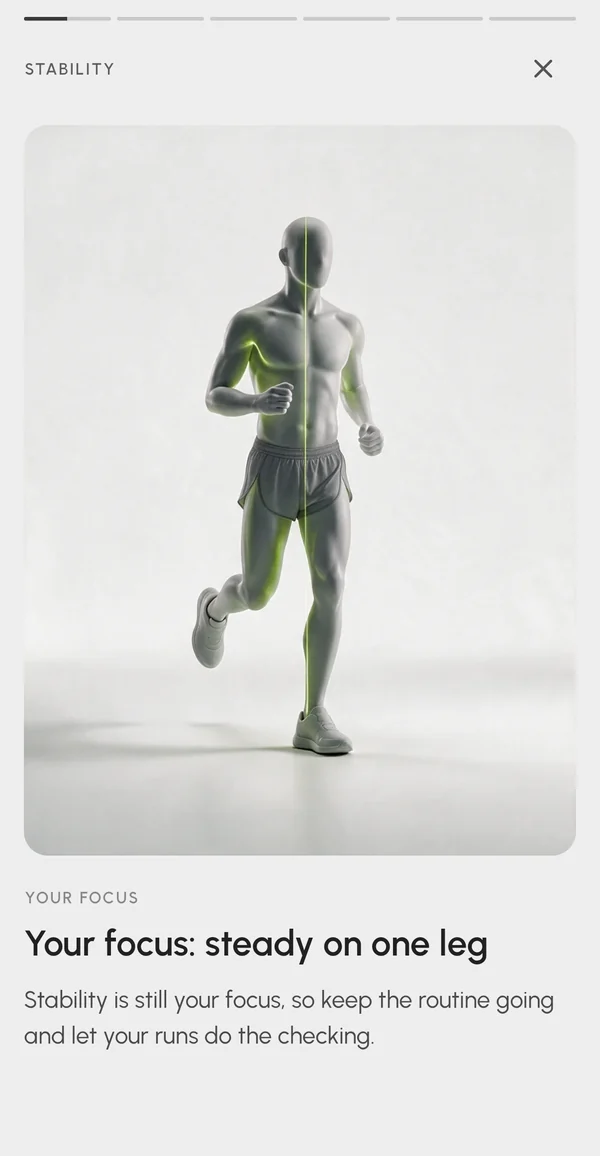

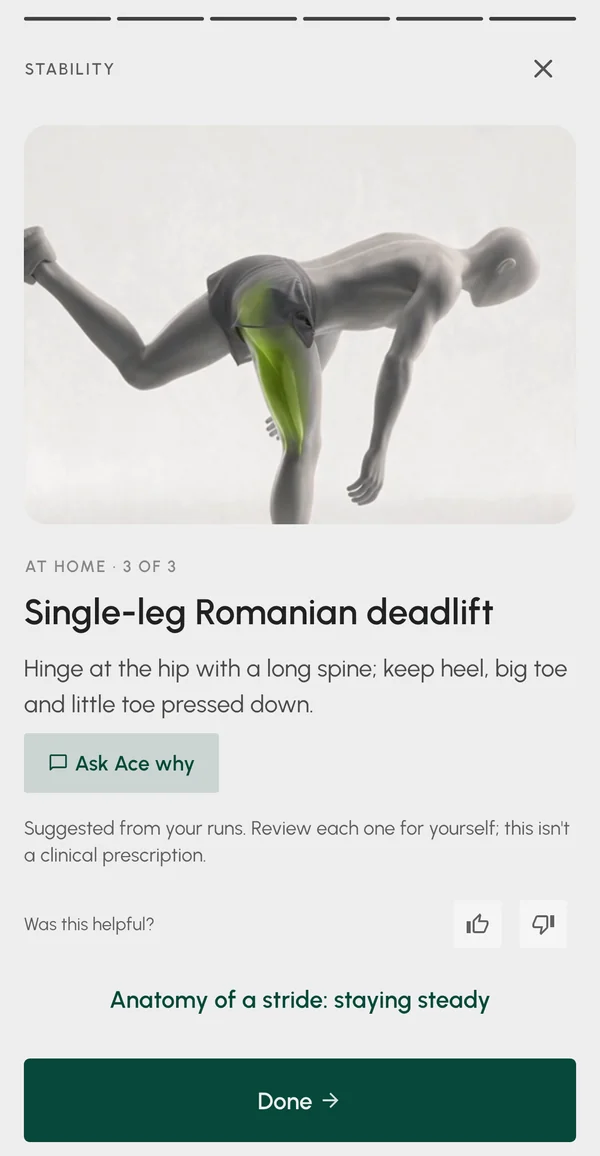
A cue for the run
One short line you can feel, like the one above. It shows again on the run setup screen, just before you start.
Why this one
Walk me through it opens a short story on why it came up in your runs and what to feel for next time.
Moves for home
A few exercises for between runs, each with a demo. Tap Ask Ace to hear what a move does.
Common questions
What are good running form cues?
Short ones that point at a result you can feel or hear, like "land quietly" or "push the ground away behind you", rather than instructions for one joint.
Even a simple instruction can do a lot. In one lab study, being told to run quietly was enough to lower runners' peak landing force.3
Should I stop paying attention to my body when I run?
No. In one study, runners who focused on their breathing or their movement used more oxygen than when they simply noticed how their body felt. Noticing how they felt cost no more than running with no instructions at all.8
Noticing how a run feels is different from steering every step.
Do I need to change my running form at all?
Not necessarily. A cue is a small experiment you can try on an easy day, not a correction you owe your stride.
If something hurts, a physio can help you work out why.
How often should runners do strength training?
One review of strength training in distance runners suggested two to three sessions a week, mixing different kinds of strength work.6
If you're new to it, a coach or physio can help you get started.
How does Ace pick my Focus?
From your own runs. Ace picks one part of your running to work on and turns it into a cue and a few exercises. If the same thing still stands out as new runs come in, your Focus stays so you can keep at it.
What if an exercise hurts?
Stop that move. The exercises are suggested from your runs, not a clinical prescription. If something hurts or is getting worse, see a physio.
References
- The effect of attentional focus on running economySchücker L, Hagemann N, Strauss B, Völker K. Journal of Sports Sciences, 2009.
- Thinking about your running movement makes you less efficient: attentional focus effects on running economy and kinematicsSchücker L, Parrington L. Journal of Sports Sciences, 2019.
- Running quietly reduces ground reaction force and vertical loading rate and alters foot strike techniquePhan X, Grisbrook TL, Wernli K, et al.. Journal of Sports Sciences, 2017.
- Cues to land softly and quietly result in acute reductions in ground reaction force loading rates in runnersSara LK, Gaudette LW, Souza Júnior JR, et al.. Gait & Posture, 2024.
- Gait retraining to reduce lower extremity loading in runnersCrowell HP, Davis IS. Clinical Biomechanics, 2011.
- Effects of Strength Training on the Physiological Determinants of Middle- and Long-Distance Running Performance: A Systematic ReviewBlagrove RC, Howatson G, Hayes PR. Sports Medicine, 2018.
- Effect of Strength Training Programs in Middle- and Long-Distance Runners' Economy at Different Running Speeds: A Systematic Review with Meta-analysisLlanos-Lagos C, Ramirez-Campillo R, Moran J, Sáez de Villarreal E. Sports Medicine, 2024.
- An internal focus of attention is not always as bad as its reputation: how specific aspects of internally focused attention do not hinder running efficiencySchücker L, Knopf C, Strauss B, Hagemann N. Journal of Sport & Exercise Psychology, 2014.
STRIV turns repeated pressure and motion signals into a personal view of how running mechanics change over time. Insights are educational, not a medical diagnosis, and they do not predict injury or measure race fitness.