
Is there a perfect running form?
No two runners move quite the same way. That's less a problem to fix than a pattern worth getting to know.

Search "perfect running form" and you get a tidy checklist: land on your midfoot, take 180 steps a minute, keep your feet under your hips, lean a little forward. Then you stand at the start of any local race and watch. Some runners bounce. Some glide. Some land heel first and still pull away in the last mile.
If one form were correct, the people up front would all look alike. They don't. So is there a perfect way to run? No, and that's good news. You don't need a textbook stride to keep doing what you love. Here's what research shows, and what's worth watching instead.
The short answer
No single running form has been shown to suit every runner. Fast runners land in different ways, runners tend to settle into an economical stride on their own, and form shifts differently from person to person as legs tire. A more useful question: does today's run look like your usual, and if not, what else changed?
What do fast runners actually look like?
At one elite-level half marathon, researchers filmed runners at the 15 km mark and analysed 283 of them. About three in four landed heel first. Among the top 50, most still did (62%).1
62%of the top 50 runners at one elite-level half marathon still landed heel first.1
That doesn't make heel striking better. It means landing heel first is common, even near the front of a fast race.
Does your body find its own stride?
Often, yes. In one lab study, runners left to choose their own stride rate landed on the one that used the least energy, both at the start and at the end of a hard hour-long run.2
In another, ten women new to running followed a 10-week program. They became more economical, meaning they used less energy at the same pace, and three changes in how they moved accounted for almost all of that gain. In the researchers' words, these beginners "naturally developed their running gait."3
Your stride isn't a blank slate waiting for the right instructions. Every run you've done has already shaped it.
Should you try to change your form?
Sometimes, for a reason. In trials that coached runners to take quicker steps, their step rate went up and the landing force built up less sharply. Whether retraining helps with pain is much less clear: across 19 trials, too few measured it.4
Changing form on purpose is a tool. It makes the most sense with a clear reason and someone who can watch you run, like a coach or physio, not because a checklist says so.
Is it normal to land a little differently every step?
Yes. No one lands exactly the same way twice, and that may be a good thing. In one early study, runners with knee pain showed less variation in how their leg joints moved together than runners without pain, and the researchers suggested some variation may serve a useful role.5
Landing the same way on every step isn't the goal.
Does your form change as you get tired?
It does, and not in the same way for everyone. When researchers pooled 33 studies on running and fatigue, they reported large differences between runners and suggested looking at each person on their own, not only at the average.6
So the way your stride changes late in a long run is yours, too.
What's worth watching instead?
Instead of measuring yourself against an ideal, get to know your usual: how you tend to run when nothing special is going on. How you land on an easy day. How even your left and right feel. Whether the last mile feels like the first.
When something shifts, the useful question isn't "is my form bad?" It's "what else changed?" Pace, hills, shoes, sleep, a busy week, a niggle that started on Tuesday.
See how today compares with your usual
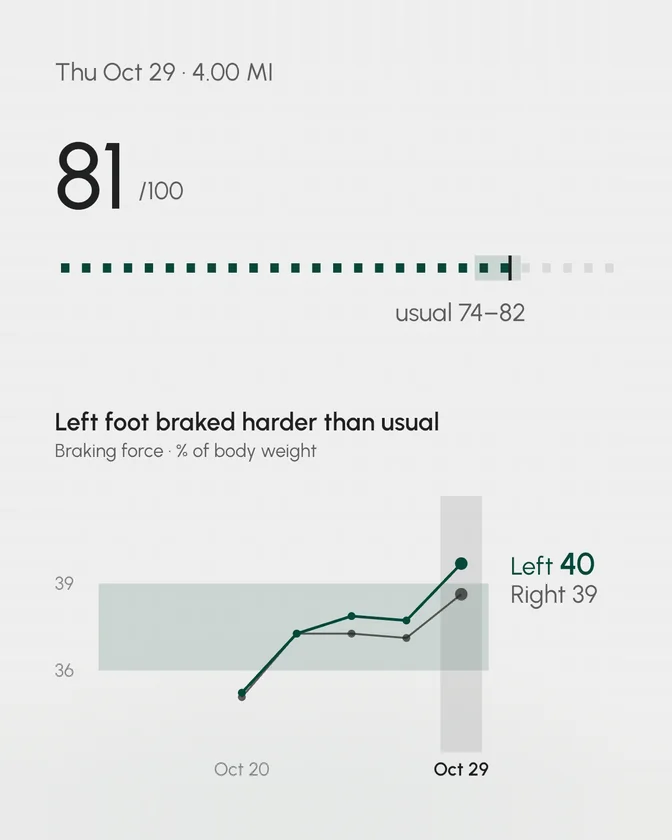
Form Score in the STRIV app is a 0–100 summary of how you ran. The more you run, the more each run is read against your own usual, not a textbook stride. After each run you see the score, how your form held up from start to finish, and where it sits next to your recent runs.
Form through the run
A line traces your form from the first step to the last and marks your best stretch of the run.
Inside the score
Open it to see impact, stability, push-off, foot progression and foot spring, each explained in plain words.
Next to your usual
Each run shows how far it sits from your recent average, so you see change against yourself, not a textbook.
Common questions
Is heel striking bad?
It's how most runners land. In the half-marathon study, about three in four runners landed heel first, including most of the top 50.1
If landing a certain way hurts, a physio can help you work out why.
Should I aim for 180 steps per minute?
There's no number everyone needs to hit. In a lab study, recreational runners who stepped 5% or 10% quicker than their own usual rate reduced the energy their knees absorbed on each step, and their hips only with the larger change.7
That's a change from your own number, not a shared target.
Do beginners need to learn proper running form?
Not necessarily. In one small study, new runners became more economical over 10 weeks of training, and the researchers described their gait as developing naturally.3
If you want help with something specific, a running coach can watch you run.
Does good running form prevent injury?
No running form has been shown to prevent injury on its own. Even some long-held rules haven't stood up: in a year-long study of 927 new runners in neutral shoes, feet that moderately rolled inward weren't injured more often than neutral feet.8
If something hurts, a physio is the right person to ask.
References
- Foot strike patterns of runners at the 15-km point during an elite-level half marathonHasegawa H, Yamauchi T, Kraemer WJ. Journal of Strength and Conditioning Research, 2007.
- Preferred and optimal stride frequency, stiffness and economy: changes with fatigue during a 1-h high-intensity runHunter I, Smith GA. European Journal of Applied Physiology, 2007.
- Mechanisms for improved running economy in beginner runnersMoore IS, Jones AM, Dixon SJ. Medicine & Science in Sports & Exercise, 2012.
- The Effectiveness of Gait Retraining on Running Kinematics, Kinetics, Performance, Pain, and Injury in Distance Runners: A Systematic Review With Meta-analysisDoyle E et al.. Journal of Orthopaedic & Sports Physical Therapy, 2022.
- A dynamical systems approach to lower extremity running injuriesHamill J, van Emmerik RE, Heiderscheit BC, Li L. Clinical Biomechanics, 1999.
- Effects of level running-induced fatigue on running kinematics: A systematic review and meta-analysisZandbergen MA et al.. Gait & Posture, 2023.
- Effects of step rate manipulation on joint mechanics during runningHeiderscheit BC et al.. Medicine & Science in Sports & Exercise, 2011.
- Foot pronation is not associated with increased injury risk in novice runners wearing a neutral shoe: a 1-year prospective cohort studyNielsen RO et al.. British Journal of Sports Medicine, 2014.
STRIV turns repeated pressure and motion signals into a personal view of how running mechanics change over time. Insights are educational, not a medical diagnosis, and they do not predict injury or measure race fitness.