
Can an AI running coach replace a human one?
A good coach and good software do different jobs. Knowing which is which helps you get more from both.

Mile four of a Tuesday easy run. Your shoulders have crept up and your steps have gone a little heavy. Nobody notices. Your coach, if you have one, will hear about Tuesday on Saturday as "fine."
So can software do a coach's job? Some of it, yes. Some of it, no, and the line between the two is worth knowing. Here's what each is good at, what research says about cues in the moment, and how the two fit together.
The short answer
Not entirely, and it doesn't need to. A good human coach brings judgment, knows your life and keeps you accountable. Software is there on every run, notices patterns across many runs and can cue you in the moment. They do different jobs and work well together. Neither replaces a physio when something hurts.
What does a good human coach actually do?
A good coach sees more than your stride. They know you flew in late last night and that you mentioned your calf in passing. They know when to push and when to tell you to rest.
One coaching researcher argues that the relationship is at the heart of coaching, and calls its quality one key factor in successful outcomes.1
That part is built on trust and time. It needs a person.
What is software good at?
Being there. It comes on the easy run nobody watches and the long run you do alone, and it remembers every run.
That memory lets it notice slow patterns, like a change that creeps in over weeks or the way your stride holds up late in a run. Those are hard to see from one session at the track. And it can speak up mid-run, while there's still time to act on it.
Can a cue during your run change how you move?
It can. In one lab study, ten runners ran on a treadmill while a screen showed them, in real time, how hard each step jolted their shin. After the program, that jolt was nearly halved, and the change held a month later.2
It works outside the lab, too. In a trial of 30 runners who landed hard, one group was cued by a small wireless sensor to take slightly quicker steps during eight sessions outside the lab. Their landing force built up less sharply, the change held 30 days later, and most kept to the cue on their own runs.3
A review of ten studies found broad agreement that real-time feedback can change how hard runners land.4
These studies measured how people ran, not whether they got hurt less. And in both trials above, a researcher chose what to change and why. The device delivered the cue.2,3
Does a cue still work once it goes quiet?
Sometimes, if you can call it back. In one trial, runners heard music-based feedback on how hard they landed over six sessions, and the feedback was slowly faded out. Six months later, they hadn't clearly kept running that way on their own. But when simply asked to run as they had at the end of the program, their landing impact dropped by about a third.5
Across 14 studies of this kind of feedback, the effect on landing impact lasted from 5 minutes to 12 months after the feedback stopped, and tended to last better when the feedback was faded out.6
So a good cue is one you can eventually give yourself.
When do you need a person, not an app?
When something hurts. Software can show how you moved, but it can't examine your knee, ask the right follow-up questions or tell you why it hurts. A physio can. If pain is sharp, swelling or getting worse, see one before your next run.
The authors of that review of ten studies suggest using real-time feedback alongside usual treatment for injured runners.4
A person also helps with the big calls, like coming back after time off or deciding whether a race goal still makes sense.
How do a coach and software work together?
Think of it as direction and follow-through. A coach sets the plan and explains the why. Software fills the days in between, with a cue on the run and a memory of every run before it.
Bring what your runs show to your coach. "My steps get heavier late in long runs" gives them more to work with than "my legs feel off." No coach? Steady feedback on ordinary runs is a good way to learn your usual.
A coach on the runs nobody watches
Ace is the coach in the STRIV app. During a run, it compares your recent steps with earlier ones and speaks up only when there's one thing worth trying. After the run, it connects today to last time and answers your questions about it.
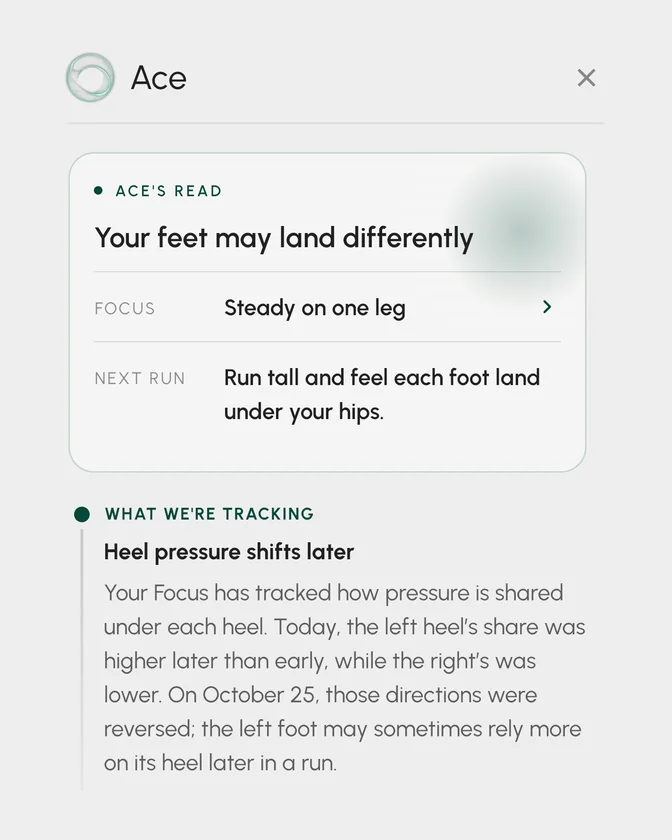
One cue, or quiet
Ace speaks when there's something specific to try. Quiet stretches mean nothing needed changing.
Ask Ace why
After the run, each cue is pinned to your route. Tap one and ask Ace why it came up.
Your kind of coach
Pick an encouraging, analytical or driven personality, set the speaking speed, or turn the voice off.
Common questions
Do I need a running coach?
Not to enjoy running. Plenty of runners never have one. A coach helps most when you have a clear goal, are coming back from a break, or want someone to watch you run and say what they see.
Does real-time feedback change your running form for good?
Not always on its own. In one trial, runners hadn't clearly kept the change six months later, but a simple reminder to run as they had at the end of the program brought a clear drop in landing impact.5
That's why a short cue you remember is worth having.
Can an AI coach tell me why something hurts?
No. At most, it can show how you moved on the runs that hurt. Finding the cause needs a physio who can examine you.
Is a voice in your ear distracting?
For some runners, yes. A cue helps most when it's short and comes when something has changed. If you'd rather run in quiet, a summary afterward can still give you one thing to try next time.
References
- Coaching effectiveness: the coach-athlete relationship at its heartJowett S. Current Opinion in Psychology, 2017.
- Gait retraining to reduce lower extremity loading in runnersCrowell HP, Davis IS. Clinical Biomechanics, 2011.
- In-field gait retraining and mobile monitoring to address running biomechanics associated with tibial stress fractureWilly RW et al.. Scandinavian Journal of Medicine & Science in Sports, 2016.
- Gait Retraining for Injured and Healthy Runners Using Augmented Feedback: A Systematic Literature ReviewAgresta C, Brown A. Journal of Orthopaedic & Sports Physical Therapy, 2015.
- Learning effects in over-ground running gait retraining: A six-month follow-up of a quasi-randomized controlled trialVan den Berghe P et al.. Journal of Sports Sciences, 2024.
- The Effect of Real-Time Tibial Acceleration Feedback on Running Biomechanics During Gait Retraining: A Systematic Review and Meta-AnalysisLi X et al.. Journal of Sport Rehabilitation, 2023.
STRIV turns repeated pressure and motion signals into a personal view of how running mechanics change over time. Insights are educational, not a medical diagnosis, and they do not predict injury or measure race fitness.