
Is 180 steps a minute right for you?
The famous number came from watching elite racers. Your own usual is a better guide.
You finish an easy loop and glance at your watch: 164 steps a minute. Later that night a forum thread tells you the magic number is 180. So you head out the next morning and try to hurry your feet, and the run feels busy, short and strange.
Is 180 the number you should be chasing? Probably not. It started as an observation of some of the fastest runners in the world, not a rule for everyone else. Here's where it came from, what moves your cadence from run to run, and what's more useful to compare against.
The short answer
Not necessarily. The 180 figure came from a coach watching elite runners race, not from a study of everyday runners. Your cadence moves with your pace, your build, your shoes and the ground under you. The range you usually run at on similar runs tells you more than a single number from a chart.
Where does 180 come from?
The number is usually credited to the running coach Jack Daniels. Watching elite runners race, he counted their steps and noticed that most of them took about 180 a minute or more.
That was a coach's observation of some of the fastest people on earth, in the middle of a race. It wasn't a study, and it wasn't about runners on an easy Sunday.
A recent review looked at how the idea holds up. Cadence varied a lot with running speed, body build, footwear and surface, and the most economical cadence differed from runner to runner instead of sitting at 180.1
Why does your cadence change with pace?
Because running faster changes your stride. In a classic lab study, recreational runners sped up across their usual range of distance paces. Their steps came only 4% quicker, while their strides grew 28% longer.2
28%longer strides as runners sped up, while their steps came only 4% quicker.2
Everyday data shows the same direction. When 256 runners shared their watch data, the pattern across the group was steady: the faster they ran, the quicker their steps came.3
So a number counted on racers moving at race pace says little about your easy run. Your own cadence on a tempo day and on a recovery jog won't match either.
Does your height change your number?
It plays a part. In a lab study of 82 recreational runners, those with longer legs tended to take fewer steps a minute. The watch-data study found the same link with leg length.4,3
But build alone can't tell you your number. In the classic lab study, measurements like height and leg length barely matched how each runner chose to stride at a given speed. The researchers concluded they couldn't be used to predict or prescribe an individual runner's stride.2
If your height can't predict your cadence, a chart built on other people can't either.
So what's a good cadence for you?
The one you usually run at, on runs like this one. That usual is fairly steady. When 31 recreational runners ran at their preferred pace on three separate days, their averages for things like cadence and time on the ground were highly consistent from day to day.5
That steadiness is what makes your usual worth knowing. A shift away from it on a familiar route at a familiar pace is easier to read than a gap from a number that was never yours.
Some runners do change their cadence on purpose, often with a coach or physio and for a clear reason. If you try it, a small change from your own number makes more sense than a jump to 180.
Does the same idea work for the rest of your stride?
It does. Take time on the ground. In 800 m and 1500 m races filmed at a track meet, runners spent less time on the ground on their first lap than on their last, and faster runners tended to spend less time on the ground overall. It moves with pace, and it can change as a race goes on.6
Or take left and right. In a lab study of 15 healthy runners, small differences between the two legs were normal, some runners showed bigger ones, and the researchers described how each runner responded to a change of pace as specific to that person.7
Neither has a single right answer either. What you can know is your own usual, and notice when today looks different.
Learn what is normal for you
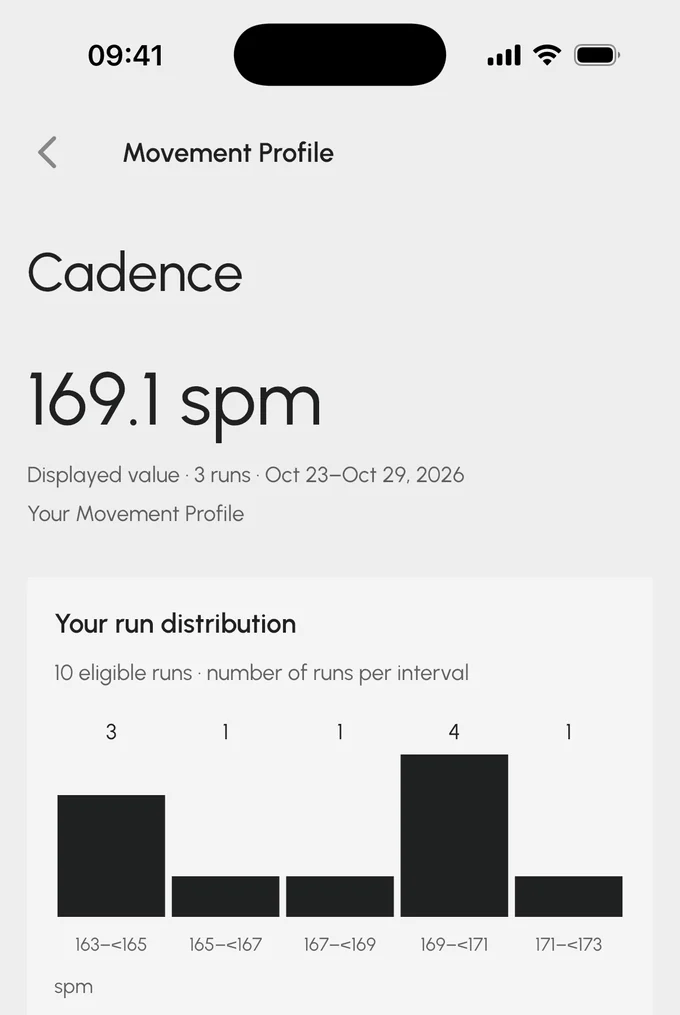
Your Movement Profile in the STRIV app learns your usual stride from your recent runs. Cadence and time on the ground each come with your own recent range, so each run is compared with yours, not an average runner's.
Find it: The Movement Profile tab, after your first few runs.
Your own range
Cadence and time on the ground each show the range from your recent runs, with a mark for where you sit now.
Left and right
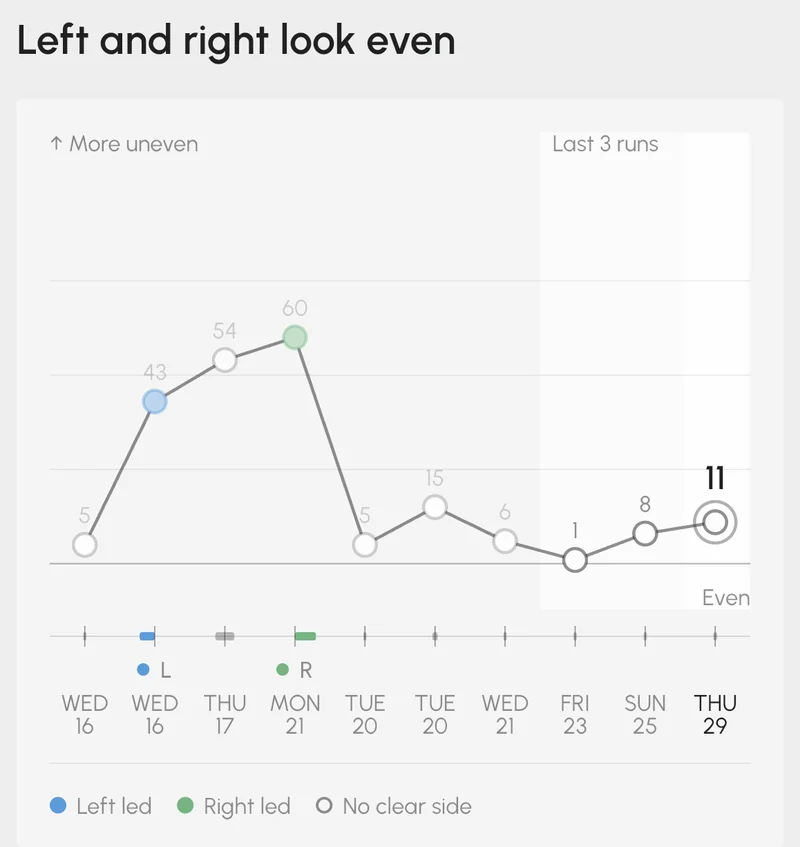
A balance chart shows, run by run, whether your left or right foot led or neither stood out.
Not a target
Higher isn't automatically better. A run outside your range is a reason to look at what else changed, like pace, shoes or tired legs.
Common questions
Is a low cadence bad?
Not on its own. In a lab study of 125 healthy and injured runners, their usual cadence wasn't linked to how sharply landing force built up.8
If something hurts when you run, a physio can help you work out why.
Should I try to run at 180 steps a minute?
Only with a reason. Quicker steps can change some things about how you move in the short term, but those changes vary from runner to runner and haven't been shown to consistently lower injury risk.1
If a coach suggests it, ask what the change is meant to help with.
Does cadence change with shoes or trails?
It can. Footwear and surface are among the things that move cadence, along with speed and body build.1
That's why it helps to compare runs in the same shoes on similar ground.
Why is my cadence lower than my friend's?
When does my Movement Profile appear?
After your first few completed runs with STRIV. It usually shows up shortly after the latest one is processed, and your Focus arrives with it.
References
- The Heel-Strike Fallacy and Cadence Beliefs in Distance Running: A Narrative ReviewPatoz A, Gindre C, Lussiana T, Breine B. Sports Medicine - Open, 2026.
- Stride length in distance running: velocity, body dimensions, and added mass effectsCavanagh PR, Kram R. Medicine & Science in Sports & Exercise, 1989.
- Inter-individual differences in stride frequencies during running obtained from wearable datavan Oeveren BT, de Ruiter CJ, Hoozemans MJM, Beek PJ, van Dieën JH. Journal of Sports Sciences, 2019.
- Is Cadence Related to Leg Length and Load Rate?Tenforde AS, Borgstrom HE, Outerleys J, Davis IS. Journal of Orthopaedic & Sports Physical Therapy, 2019.
- On the number of steps required to measure the mean and variability of spatio-temporal parameters at preferred running speedGodin A, Eustache E, Sagawa Y Jr, Mourot L. Journal of Biomechanics, 2025.
- Foot strike patterns and ground contact times during high-calibre middle-distance racesHayes P, Caplan N. Journal of Sports Sciences, 2012.
- Kinetic Asymmetry during Running at Preferred and Nonpreferred SpeedsFurlong LM, Egginton NL. Medicine & Science in Sports & Exercise, 2018.
- Relationships between Habitual Cadence, Footstrike, and Vertical Load Rates in RunnersFutrell EE, Jamison ST, Tenforde AS, Davis IS. Medicine & Science in Sports & Exercise, 2018.
STRIV turns repeated pressure and motion signals into a personal view of how running mechanics change over time. Insights are educational, not a medical diagnosis, and they do not predict injury or measure race fitness.